web design
digital growth
the difference between a landing page and a full website
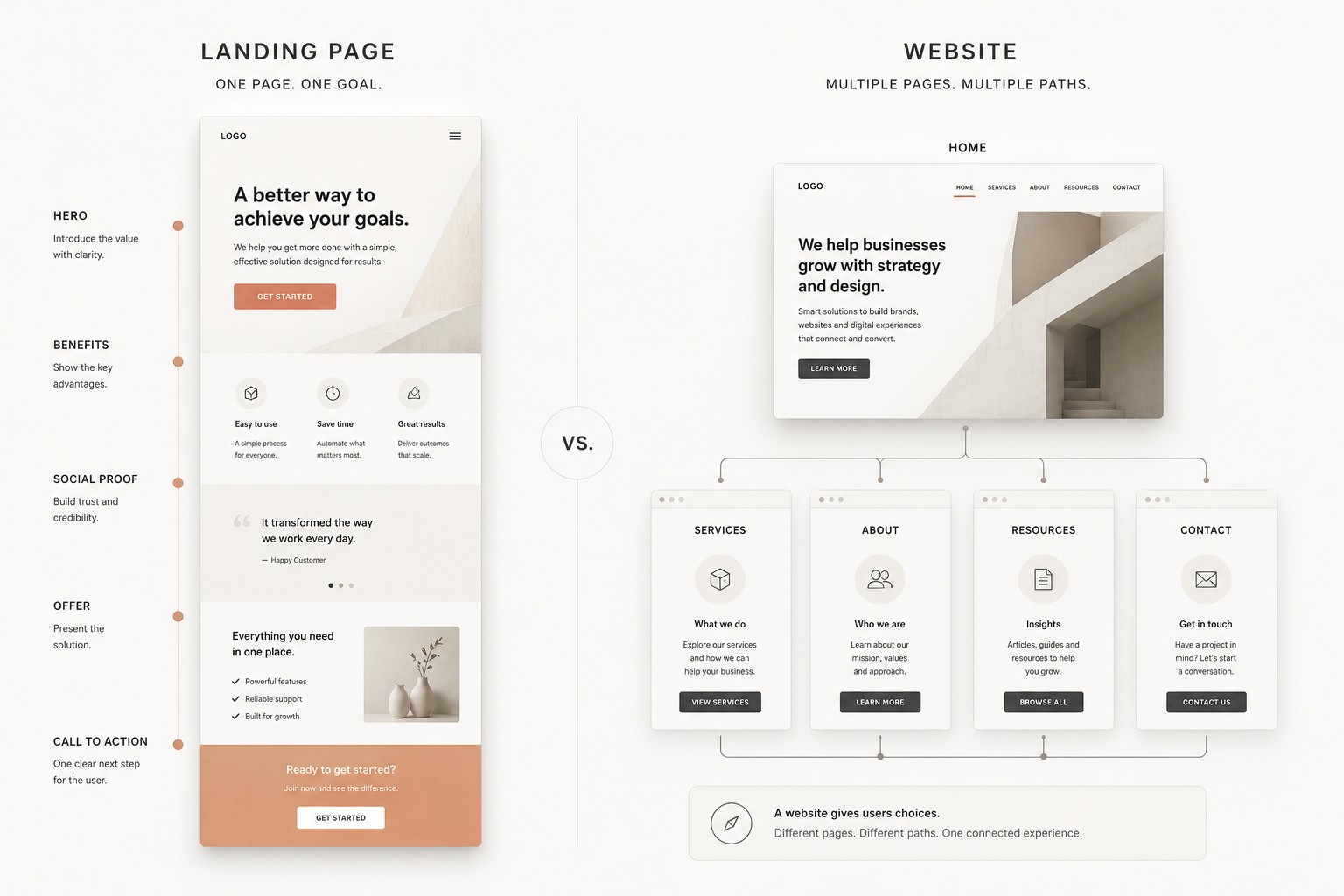
a landing page is a focused web page built around one main objective, such as collecting sign-ups, presenting an offer, or supporting a campaign. a full website is a broader digital presence made of multiple pages that help people understand a business, explore its services, and decide what to do next. the main difference is scope.
May 15, 2026
the difference between a landing page and a full website
Ed T.
people often use “landing page” and “website” as if they mean the same thing. that confusion makes sense, as they both live online, both can include text, images, forms, and buttons, and both may be designed with care.
still, they serve different purposes.
when someone asks for a landing page, they are usually asking for a focused page with a specific goal. when someone asks for a website, they are usually asking for a larger structure that explains a business more fully and supports different types of visitors over time.
understanding that difference helps with planning, content, design, and expectations.
what is a landing page?

a landing page is a standalone web page that someone reaches after clicking a link from an ad, email, social post, or another digital source. it is usually created for a specific objective and a specific audience.
that objective may be:
signing up for a newsletter
registering for an event
downloading a guide
requesting a quote
learning about one specific service or offer
because the goal is focused, the page is focused too.
a landing page usually includes a clear headline, a short explanation of the offer, relevant details, proof or context when needed, and one main call to action. depending on the strategy, it may have limited navigation so the visitor can stay close to the intended path.
we can think of a landing page as a direct conversation. it answers one immediate question: “what is this, and what should i do next?”
what is a full website?
a website is a collection of web pages that belong to the same domain and are maintained as one digital property.
for a business, that usually means a larger system of pages such as:
home
about
services or products
contact
work, portfolio, or case studies
blog or resources, when relevant
a website has a broader responsibility than a landing page. it helps people understand who the business is, what it offers, who it serves, and why someone may choose to get in touch.
it also supports different kinds of visitors. one person may arrive knowing exactly what they need. another may still be comparing options. another may want to understand the team, the process, or the experience behind the service.
a full website gives these visitors more than one route.
the main difference is scope
the clearest way to explain the distinction is this: a landing page is narrow in scope. a full website is broad in scope.
a landing page works around one central message and one main action. a website organizes many messages across many pages so people can explore, compare, and build understanding.
that difference affects almost every part of the work:
content scope
a landing page contains only the information needed to support its goal: it may explain one service, one campaign, one event, or one offer.
a full website carries a wider body of content: it may need to explain the business model, service categories, process, team, frequently asked questions, proof of experience, and ways to contact or purchase.
structural scope
a landing page often follows a linear reading experience: the visitor moves from headline to details to call to action.
a website needs a navigation system: people move between pages, compare sections, and choose their own path based on what they need.
strategic scope
a landing page supports a focused action.
a website supports the business as a whole.
that does not make one more important than the other. it means each one solves a different problem.
how the user journey changes
the user journey on a landing page is usually direct:
someone arrives
they understand the message
they decide whether to act
that journey is intentionally short.
the journey on a full website is often more layered:
someone arrives
they explore the business
they compare services, information, or proof
they build enough understanding to take action
research in user experience separates these kinds of pathways because people do not always move through digital experiences in the same way. some interactions are direct and task-driven. others involve a broader sequence of steps and decisions.
this matters because design follows purpose. if the purpose is immediate conversion around one message, a landing page may be enough. if the purpose is to support understanding across several questions, a full website is usually more appropriate.
can a landing page be part of a full website?
yes. in many cases, that is the most useful setup. a company may have a website and still create landing pages for specific needs, such as:
a campaign promoting a new service
a registration page for a workshop or webinar
a page connected to a paid ad
a focused page for one audience or one offer
in that case, the landing page does not replace the website, but works beside it.
the website gives the business a stable digital presence. the landing page supports a specific action within that larger ecosystem.
can a landing page replace a website?
sometimes, for a limited purpose.
a new business may start with a simple landing page while its larger website is still being planned. a short-term event may only need one registration page. a product test may begin with a focused page to measure interest.
but when a business needs to explain itself in more depth, a landing page usually becomes too small for the job. it can start carrying too much responsibility:
too many services
too many messages
too many audience types
too many decisions packed into one page
when that happens, clarity suffers. the page may feel crowded, and the visitor may struggle to understand what matters most.
how scope affects planning
choosing between a landing page and a website also changes the work behind the scenes.
content planning
a landing page requires a precise message: the team needs to define one main audience, one main problem, and one main action.
a website requires a broader content system: the team must decide how information is grouped, how pages connect, and what each section is responsible for explaining.
design planning
a landing page design usually centers on hierarchy and momentum: the page should guide attention toward the intended action.
a website design must also handle orientation: people need to know where they are, what else exists, and how to keep exploring.
search visibility
a landing page can be useful for campaigns and focused queries, especially when it aligns tightly with a specific message.
a website has more room to build search visibility over time through multiple pages, structured information, and educational content that answers recurring questions.
investment and timeline
a landing page usually has a smaller scope than a full website, though it still requires strategy, writing, design, and technical care.
a website usually involves more pages, more content decisions, a stronger navigation structure, and a fuller understanding of the business.
the difference in investment comes from the difference in responsibility.
how to choose between one and the other
a landing page may be the right choice when:
there is one clear message
there is one clear action
the need is tied to a campaign, launch, form, or event
the visitor does not need to explore a broader business story before acting
a full website may be the right choice when:
the business needs to explain itself clearly
there are multiple services, products, or audiences
people need more context before contacting or buying
the digital presence should support trust, discovery, and ongoing communication
the decision becomes easier when we ask: how much does the visitor need to understand before taking the next step?
if the answer is “just this one thing,” a landing page may fit.
if the answer is “the business, its offer, and how everything connects,” a full website is usually the clearer choice.
a simple way to explain the difference
a landing page is one focused page built around one main action.
a full website is a larger set of connected pages built to explain a business more ly.
both can be useful. both can be well designed. both can support growth and communication.
they simply operate at different scopes.
to wrap it up
choosing between a landing page and a full website depends on scope. a landing page helps communicate one focused message and guide people toward one main action. a full website gives a business more room to explain itself, organize information, and support different visitor needs.
when the objective is specific, a landing page can be enough. when the communication needs are broader, a full website usually provides the clearer structure.
sources
Mailchimp, “what is a landing page?” and “about landing pages” (Mailchimp)
MDN Web Docs, “site” glossary definition (MDN Web Docs)
Nielsen Norman Group, “user journeys vs. user flows” and “understanding user pathways in analytics” (Nielsen Norman Group)